

Peripheral neuropathy is common.
Clear, structured neuropathy care is not.
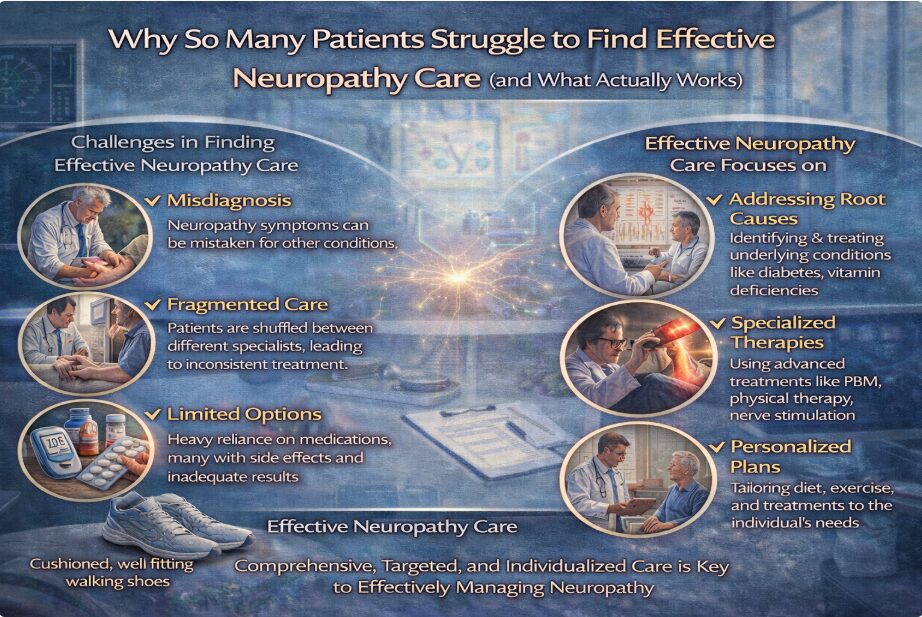
Many patients move from appointment to appointment. They undergo testing. They receive prescriptions. Yet they still feel uncertain about what is happening or whether anything is improving.
That frustration is understandable.
Neuropathy is complex. But confusion around neuropathy care often stems from fragmentation rather than impossibility.
After more than 20 years focused exclusively on peripheral neuropathy — and working with thousands of patients — consistent patterns appear.
Understanding those patterns changes expectations.
Why Neuropathy Care Often Feels Incomplete
Most medical visits are structured to answer one question:
“What is the diagnosis?”
But neuropathy management requires a different question:
“Is this progressing, stabilizing, or improving?”
Without structured measurement over time, patients are left tracking symptoms subjectively.
Over-Reliance on Testing
Electrodiagnostic testing such as EMG and nerve conduction studies are valuable tools. However, they primarily evaluate large nerve fibers.
Small fiber neuropathy — which commonly causes burning, tingling, and temperature sensitivity — may not be detected on routine EMG testing.¹
When tests appear normal, patients may feel dismissed, even though symptoms persist.
Understanding the limitations of testing is essential.
Symptom Suppression Is Not the Same as Nerve Improvement
Medication can reduce discomfort.
But pain reduction does not automatically mean nerve function is improving.
Neuropathy progression is often slow. So is improvement.
Structured follow-up allows clinicians to evaluate change over time rather than relying on symptom fluctuation alone.
Lack of Structured Follow-Up
Neuropathy rarely resolves in a single visit.
Effective management often requires:
- Baseline measurement
- Ongoing reassessment
- Adjustment based on response
- Functional tracking
Without structure, it becomes difficult to determine whether interventions are helping.
What Actually Helps
Across thousands of neuropathy cases, several principles consistently matter:
- Pattern recognition
- Objective measurement
- Consistency
- Individualization
Peripheral neuropathy rarely exists in isolation. Contributing factors may include metabolic dysfunction, medication effects, structural involvement, vascular changes, or autonomic influence.
Care improves when evaluation integrates these contributors rather than isolating them.
The Most Important Takeaway
Neuropathy care feels frustrating when it lacks structure.
When evaluation is methodical and progress is measured objectively, clarity improves — even if change is gradual.
Effective management is less about chasing quick fixes and more about disciplined, structured care.
Frequently Asked Questions
Q: Can neuropathy improve?
A: Some forms of neuropathy can stabilize or improve depending on the underlying contributors and consistency of care.
Q: Why is neuropathy difficult to treat?
A: Neuropathy often has multiple contributing factors and typically progresses gradually. Effective management requires structured monitoring rather than a single intervention.
Q: Is medication the only option?
A: Medication may help with symptom control, but comprehensive management may involve additional strategies depending on contributing factors.
Next Step
If you have been told your neuropathy “just needs to be managed” but still feel uncertain about progression, a structured neuropathy evaluation can provide clarity.
To learn more or request a consultation at Realief Neuropathy Centers of Minnesota, call 952-456-6160 or submit a request through our website.
Early clarity can influence long-term trajectory.
About the Author
Dr. Timothy Kelm is the founder of Realief Neuropathy Centers of Minnesota and has spent over 20 years focused exclusively on the evaluation and treatment of peripheral neuropathy. He has worked with thousands of neuropathy patients and delivered tens of thousands of neuropathy-focused treatments.
He is associated with published clinical research conducted in collaboration with the University of Minnesota and holds a nationally issued patent related to neuropathy treatment methodology. He has delivered public educational presentations and trained physicians nationally on structured neuropathy care.
Over 20 years ago, his interest in neuropathy began after repeatedly seeing patients who were told there were no good options. He believed then — and continues to believe today — that neuropathy should not define your life.
References
- American Association of Neuromuscular & Electrodiagnostic Medicine. Electrodiagnostic testing overview.