
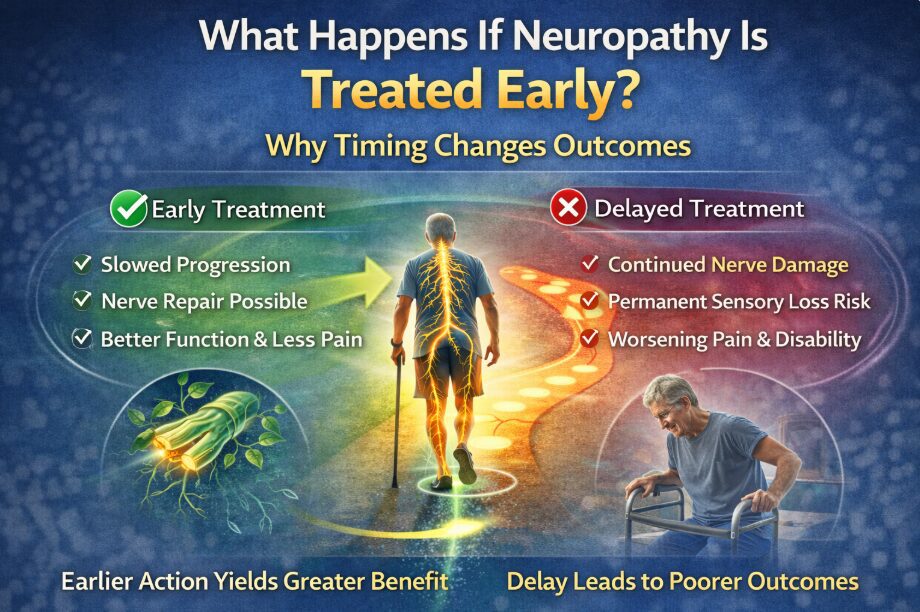

Many patients ask:
“If I catch this early, does it make a difference?”
The answer is:
Yes — timing matters.
Neuropathy does not typically worsen overnight.
But gradual progression can lead to structural nerve change and deconditioning over time.
Earlier intervention often produces more predictable and efficient improvement.
Why Early Neuropathy Is More Responsive
Peripheral nerves have regenerative capacity.
When dysfunction is addressed early:
- Nerve signaling may improve more efficiently
- Structural damage may be less advanced
- Sensory pathways may be more intact
- Compensation patterns may be less established
The longer nerves remain under metabolic or vascular stress, the more change can accumulate.
For more on progression patterns, see: Is Neuropathy a Progressive Disease?
The Deconditioning Factor
Neuropathy affects more than sensation.
Over time, patients often reduce activity because of:
- Instability
- Fear of falling
- Fatigue
- Tightness
Reduced movement leads to:
- Muscle weakness
- Loss of ankle stability
- Slower reflex correction
- Increased balance vulnerability
When neuropathy is treated early, deconditioning is often less severe — making balance recovery more efficient.
For more on balance recovery, see: Can Balance Be Restored in Neuropathy?
Pain Is Not the Only Indicator
Many people assume they should seek treatment when pain becomes severe.
But in over 20 years of focused neuropathy practice, many patients present with:
- Minimal pain
- But progressive instability or weakness
Early-stage neuropathy is often quieter.
That does not mean it is less important.
Pain suppression alone does not restore nerve performance.
Addressing nerve signaling early can help preserve balance and function.
What Early Improvement Can Look Like
When neuropathy is addressed early, patients may experience:
- Faster measurable sensory improvement
- More predictable balance gains
- Greater walking endurance
- Reduced compensatory tightness
Improvement still requires consistency.
But the trajectory is often more favorable.
For timeline expectations, see: How Long Does Neuropathy Take to Improve?
What Happens If You Wait?
Untreated neuropathy commonly progresses.
Over time, patients may experience:
- Expanding numbness
- Increasing instability
- Reduced walking tolerance
- Greater deconditioning
For more on advanced stages, see: What Are the Final Stages of Neuropathy?
Waiting does not typically allow neuropathy to resolve on its own.
For more on that, see: Does Neuropathy Ever Go Away?
Is Early Treatment a Guarantee?
No.
Early treatment does not guarantee complete reversal.
For more on reversal potential, see: Can Nerve Damage Be Reversed?
But earlier intervention often produces:
- More efficient measurable gains
- Greater sensory preservation
- Better balance outcomes
- Reduced rehabilitation burden
Timing influences magnitude.
The Most Important Takeaway
Treating neuropathy early does not mean panic.
It means efficiency.
Peripheral nerves retain capacity for measurable improvement.
The earlier nerve dysfunction is addressed:
- The less structural change may accumulate
- The less deconditioning develops
- The more predictable recovery tends to be
Neuropathy does not typically resolve on its own.
Early intervention helps preserve independence.
Timing shapes trajectory.
Frequently Asked Questions
Does early neuropathy respond better to treatment?
Yes. Earlier-stage neuropathy often improves more predictably.
Should I wait until symptoms are severe?
Waiting typically allows progression and deconditioning to accumulate.
Is early treatment a cure?
Not necessarily, but it may increase efficiency and magnitude of improvement.
What if my neuropathy is already advanced?
Improvement is still possible, but structured rehabilitation may require more consistency.
Next Step
If you have noticed early changes in sensation, balance, or walking endurance — even without severe pain — structured evaluation can clarify your stage and improvement potential.
To learn more or request a consultation at Realief Neuropathy Centers of Minnesota, call 952-456-6160 or submit a request through our website.
Early action is not about fear.
It is about efficiency.
About the Author
Dr. Timothy Kelm is the founder of Realief Neuropathy Centers of Minnesota and has spent over 20 years focused exclusively on the evaluation and treatment of peripheral neuropathy. He has worked with thousands of neuropathy patients and delivered tens of thousands of neuropathy-focused treatments.
He is associated with published clinical research conducted in collaboration with the University of Minnesota and holds a nationally issued patent related to neuropathy treatment methodology. He has delivered public educational presentations and trained physicians nationally on structured neuropathy care.
Over 20 years ago, his interest in neuropathy began after repeatedly seeing patients who were told there were no good options. He believed then — and continues to believe today — that neuropathy should not define your life.