

When someone is diagnosed with peripheral neuropathy, the first questions are rarely about lab values.
They are about the future.
- Is this progressive?
- Will it shorten my life?
- Can it spread to my brain or heart?
- Will I lose my independence?
- Can it be cured?
This guide answers those questions clearly — without fear-based exaggeration and without minimizing real risk.
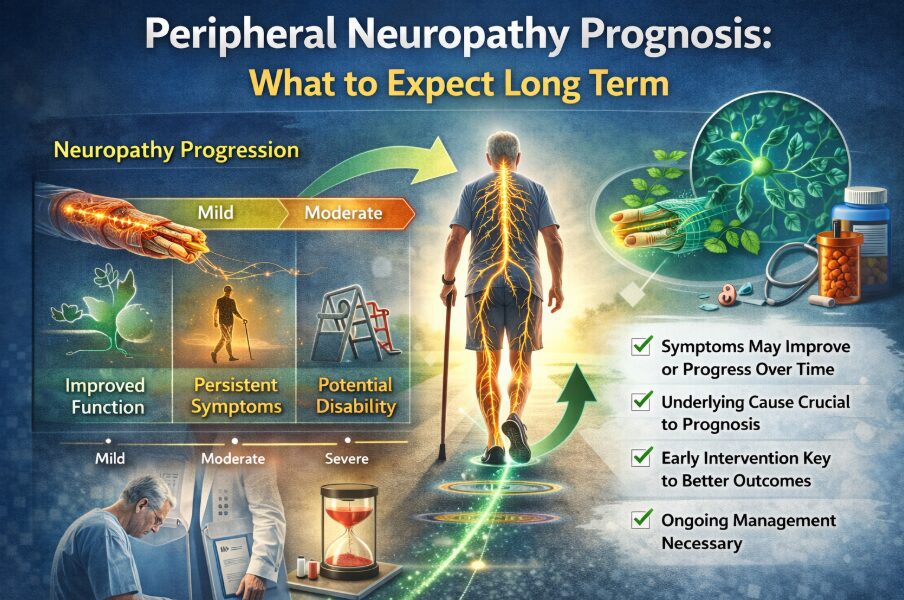
Peripheral neuropathy rarely shortens lifespan directly.
But untreated neuropathy commonly progresses.
Understanding what that progression looks like — and how it can be influenced — is essential.
Is Neuropathy Progressive?
In most chronic cases, untreated neuropathy tends to progress gradually over time.
Symptoms typically begin in the toes and move upward in a predictable length-dependent pattern.
For a detailed breakdown, see:
Is Neuropathy a Progressive Disease?
Progressive does not mean hopeless.
Peripheral nerves retain capacity for measurable improvement — especially when addressed earlier rather than later.
How Fast Does Neuropathy Progress?
Progression speed varies based on:
- Underlying cause
- Metabolic control
- Vascular health
- Duration of symptoms
- Timing of intervention
For a full explanation, see:
How Fast Does Neuropathy Progress?
Most neuropathy progresses gradually — not suddenly.
But gradual decline can still significantly affect balance and independence if ignored.
Can Neuropathy Spread to the Brain or Heart?
Peripheral neuropathy does not spread into the brain.
For clarification, see:
Does Neuropathy Spread to the Brain?
It also does not damage the heart muscle.
However, certain advanced systemic conditions may involve autonomic nerves that regulate heart rate and blood pressure.
For details, see:
Does Neuropathy Affect the Heart?
Understanding anatomy reduces unnecessary fear.
Does Neuropathy Spread Up the Body?
When symptoms move upward in the legs — or eventually involve the hands — this reflects predictable nerve length patterns, not organ invasion.
Learn more here:
Does Neuropathy Spread Up the Body?
Does Neuropathy Spread to the Hands?
Location matters less than timing.
What Are the Final Stages of Neuropathy?
There is no universal “terminal stage.”
Advanced neuropathy typically means:
- Significant sensory loss
- Increased fall risk
- Reduced endurance
- Possible deconditioning
Alarmist advertising often exaggerates amputation risk.
The reality is more nuanced.
For a balanced explanation, see:
What Are the Final Stages of Neuropathy?
Neuropathy alone does not automatically lead to amputation.
Can Neuropathy Cause Death?
Peripheral neuropathy itself rarely causes death.
When mortality is discussed, it is typically due to underlying systemic disease — not nerve damage alone.
Learn more here:
Can Neuropathy Cause Death?
Neuropathy primarily affects function and independence.
Is Neuropathy a Disability?
Not automatically.
Disability depends on functional limitation, not diagnosis alone.
Advanced neuropathy can impair work capacity and balance stability.
However, measurable improvements in strength and balance are often achievable.
For more, see:
Is Neuropathy a Disability?
Can You Live a Normal Life With Neuropathy?
Yes — many people do.
Quality of life depends heavily on:
- Stage
- Balance stability
- Deconditioning
- Timing of intervention
Learn more here:
Can You Live a Normal Life With Neuropathy?
Earlier intervention often preserves independence more effectively than waiting until instability becomes advanced.
Can Neuropathy Be Cured?
In most chronic cases, neuropathy is not completely erased.
However, measurable improvements in nerve function are achievable.
For a full explanation, see:
Can Neuropathy Be Cured?
Improvement does not require total disappearance.
It requires altering trajectory.
Should You Stay Active?
Yes — with guidance.
Walking and movement support circulation, strength, and balance.
Complete inactivity often accelerates decline.
For detailed guidance, see:
Should You Walk With Neuropathy?
Safe, structured movement supports long-term function.
The Most Important Truth About Neuropathy Prognosis
Peripheral neuropathy is commonly progressive when untreated.
It rarely shortens life directly.
Its primary impact is on:
- Sensation
- Balance
- Endurance
- Independence
But peripheral nerves retain capacity for measurable improvement.
In clinical practice, improvements may include:
- Increased light-touch detection
- Improved vibration sense
- Reduced burning intensity
- Improved balance stability
- Increased walking endurance
Earlier intervention tends to produce more predictable and meaningful gains.
Progression is common.
Catastrophe is not inevitable.
Timing shapes trajectory.
Next Step
If you are noticing gradual changes in sensation, balance, endurance, or nighttime symptoms, earlier structured evaluation often allows for more efficient intervention before deficits become advanced.
To learn more or request a consultation at Realief Neuropathy Centers of Minnesota, call 952-456-6160 or submit a request through our website.
Neuropathy does not define your future.
Timing influences outcome.
About the Author
Dr. Timothy Kelm is the founder of Realief Neuropathy Centers of Minnesota and has spent over 20 years focused exclusively on the evaluation and treatment of peripheral neuropathy. He has worked with thousands of neuropathy patients and delivered tens of thousands of neuropathy-focused treatments.
He is associated with published clinical research conducted in collaboration with the University of Minnesota and holds a nationally issued patent related to neuropathy treatment methodology. He has delivered public educational presentations and trained physicians nationally on structured neuropathy care.
Over 20 years ago, his interest in neuropathy began after repeatedly seeing patients who were told there were no good options. He believed then — and continues to believe today — that neuropathy should not define your life.