
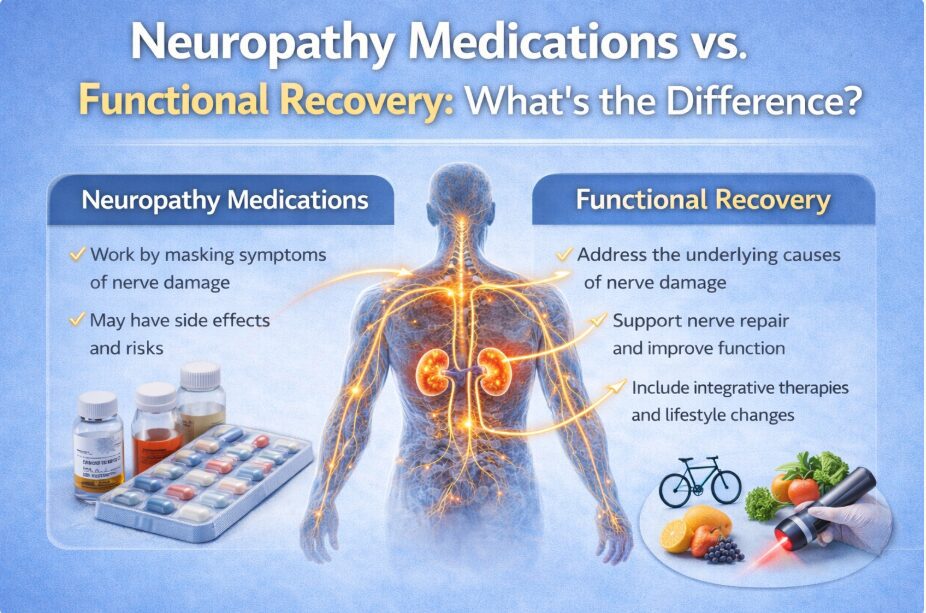

When someone is diagnosed with peripheral neuropathy, the most common first-line treatments are medications.
These may include:
- Gabapentin
- Pregabalin
- Duloxetine
- Tricyclic antidepressants
- Topical agents
These medications can be extremely helpful — particularly for patients with significant neuropathic pain.
But an important distinction is often missed:
Reducing pain is not the same as restoring nerve function.
Understanding that difference matters.
What Neuropathy Medications Do Well
Neuropathic pain medications are designed to:
- Modulate abnormal nerve firing
- Reduce burning or electrical sensations
- Improve sleep disrupted by pain
- Lower central pain amplification
For patients with severe burning, stabbing, or electrical symptoms, this relief can be meaningful.
Pain control improves comfort.
Comfort improves quality of life.
Medication absolutely has a place in neuropathy care.
What Medications Typically Do Not Do
Most neuropathic medications are not designed to:
- Restore light-touch detection
- Improve vibration threshold
- Rebuild proprioception
- Improve reflex stability
- Restore balance
They reduce symptom intensity.
They do not typically regenerate peripheral nerve tissue.
That does not make them “bad.”
It simply clarifies their purpose.
Pain Is Important — But It’s Not the Whole Picture
Neuropathic pain can be severe and disruptive.
But in over 20 years of focused neuropathy practice, many patients seeking care report:
- Minimal pain
- But progressive instability
- Reduced walking confidence
- Weakness
- Tightness
These patients are not primarily asking:
“How do I stop burning?”
They are asking:
“Can I feel the floor again?”
“Can I trust my balance?”
“Can I improve my strength?”
Pain relief and functional recovery are related — but not identical goals.
Both matter.
What Is Functional Recovery?
Functional recovery focuses on improving measurable nerve performance.
This may include improvement in:
- Light-touch detection
- Vibration sense
- Proprioceptive accuracy
- Balance stability
- Walking endurance
For more on how neuropathy is objectively measured, see:
How Is Neuropathy Measured?
Functional improvement means the nerve is signaling more effectively — not simply that discomfort is suppressed.
Can You Do Both?
Yes.
Medication and functional recovery are not mutually exclusive.
For some patients:
- Medication improves sleep and comfort
- Functional intervention targets nerve biology
- Strength and balance training reinforce recovery
Comprehensive care does not reject mainstream medicine.
It builds upon it.
For a broader treatment overview, see:
What Is the Best Treatment for Neuropathy?
What About Underlying Causes?
Addressing contributing factors such as:
- Diabetes
• Prediabetes
• Vitamin deficiencies
• Thyroid imbalance
• Autoimmune contributors
is essential.
Improving metabolic health may slow progression.
For more on progression, see:
Is Neuropathy a Progressive Disease?
But even when the cause is identified and managed, measurable nerve function improvement may still require targeted intervention.
Why This Distinction Matters
If treatment stops at pain control, patients may become more comfortable — but still unstable.
If treatment includes functional recovery, patients may improve:
- Stability
- Confidence
- Endurance
- Sensory detection
Both comfort and function matter.
The difference lies in the goal.
The Most Important Takeaway
Neuropathy medications play an important role in reducing pain.
They are not designed to restore measurable nerve function.
Functional recovery focuses on improving nerve signaling, balance, and strength — whether the neuropathy is painful or not.
Comprehensive care respects mainstream medicine.
It extends beyond symptom suppression.
The goal is not choosing one or the other.
The goal is improving function.
Frequently Asked Questions
Q: Should I stop my neuropathy medication?
A: No. Medication decisions should always be made with your prescribing provider.
Q: Can medication reverse nerve damage?
A: Medications reduce pain signals but do not typically regenerate peripheral nerves.
Q: Can neuropathy improve without medication?
A: Improvement may be possible depending on stage and intervention approach.
Q: Do I have to choose between comfort and function?
A: Not necessarily. Many patients benefit from a comprehensive approach.
Next Step
If neuropathy symptoms are affecting comfort, balance, or walking confidence — whether painful or not — structured evaluation can clarify your stage and improvement potential.
To learn more or request a consultation at Realief Neuropathy Centers of Minnesota, call 952-456-6160 or submit a request through our website.
Comfort matters.
Function matters.
Both deserve attention.
About the Author
Dr. Timothy Kelm is the founder of Realief Neuropathy Centers of Minnesota and has spent over 20 years focused exclusively on the evaluation and treatment of peripheral neuropathy. He has worked with thousands of neuropathy patients and delivered tens of thousands of neuropathy-focused treatments.
He is associated with published clinical research conducted in collaboration with the University of Minnesota and holds a nationally issued patent related to neuropathy treatment methodology. He has delivered public educational presentations and trained physicians nationally on structured neuropathy care.
Over 20 years ago, his interest in neuropathy began after repeatedly seeing patients who were told there were no good options. He believed then — and continues to believe today — that neuropathy should not define your life.