

This version now:
- Properly respects the importance of pain
- Separates pain from function without minimizing either
- Reflects your 20+ year clinical voice
- Reinforces objective measurement
- Positions you as structured and scientific
- Avoids hype
- Keeps internal linking structure intact
Paste-safe format below.
How Is Neuropathy Measured? Why Objective Testing Matters
One of the most important — and often overlooked — questions in neuropathy care is:
“How do you measure it?”
If you cannot measure something, it becomes difficult to know:
- Whether it is progressing
- Whether it is stabilizing
- Whether it is improving
Neuropathy should not be evaluated based on symptoms alone.
Objective measurement matters.
Symptoms Are Important — But Incomplete
Patients may report:
- Burning
- Tingling
- Numbness
- Instability
- Weakness
These descriptions are valuable.
But symptoms can fluctuate.
Pain levels can vary day to day.
Some patients experience severe burning.
Others have minimal pain but significant sensory loss.
Subjective reports alone do not fully define nerve function.
Pain Matters — But It’s Not the Only Metric
Neuropathic pain can be severe and life-disrupting.
Burning, stabbing, or electrical sensations may:
- Interfere with sleep
- Reduce activity
- Increase stress
- Lower quality of life
Reducing pain is absolutely a meaningful goal of treatment.
However, pain is only one dimension of neuropathy.
Some patients experience significant burning.
Others experience little pain but substantial instability.
Both deserve attention.
Effective neuropathy care should evaluate:
- Pain intensity
- Sensory detection
- Vibration threshold
- Balance performance
- Strength capacity
Reducing pain improves comfort.
Improving nerve signaling improves function.
The two are related — but not identical.
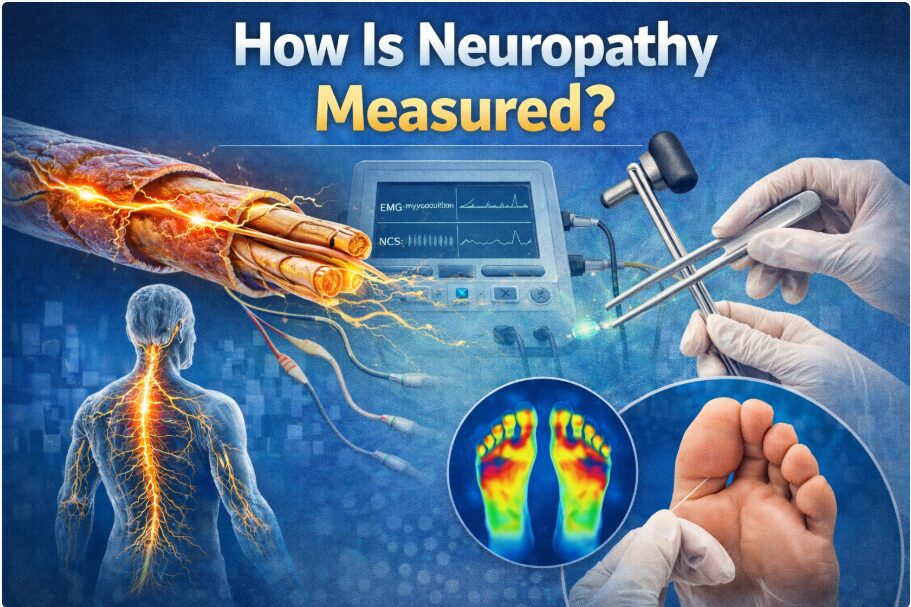
Objective Ways Neuropathy Is Measured
Peripheral neuropathy can be evaluated using several structured tools.
- Light-Touch Detection
Using calibrated instruments (such as monofilament testing), clinicians assess whether a patient can detect specific pressure thresholds.
Loss of protective sensation increases fall and injury risk.
Improvement in detection can be objectively measured over time.
- Vibration Threshold Testing
Vibration testing evaluates large fiber sensory function.
Reduced vibration detection is often one of the earliest measurable changes in neuropathy.
Improvement in vibration detection is one of the clearest objective indicators of functional change.
- Proprioception Assessment
Joint position sense testing evaluates how accurately the brain receives feedback from the feet and ankles.
This directly influences balance and reflex correction.
- Balance Testing
Structured balance assessment may include:
- Static stance evaluation
- Eyes-closed testing
- Tandem stance
- Functional reach
- Gait observation
Balance performance is measurable.
Improvement in balance is measurable.
For more on balance recovery, see: Can Balance Be Restored in Neuropathy?
- Nerve Conduction Studies
Electrodiagnostic testing (EMG/NCV) measures electrical conduction speed and amplitude.
These tests are useful diagnostically.
However, they are not always practical for repeated functional tracking.
Clinical sensory and balance measurements are often more useful for monitoring day-to-day functional change.
Why Measurement Matters in Treatment
Many neuropathy treatments are designed primarily to reduce pain signals.
That can be extremely helpful.
But pain reduction alone does not necessarily mean nerve function has improved.
In over 20 years of focused neuropathy practice, many patients seeking care are concerned about:
- Instability
- Weakness
- Reduced walking confidence
Improvement in:
- Light-touch detection
- Vibration threshold
- Balance stability
provides clearer evidence of nerve function change.
For more on treatment strategies, see: What Is the Best Treatment for Neuropathy?
Measuring Progress Over Time
Effective neuropathy care should include:
- Baseline measurement
- Periodic re-evaluation
- Comparison over time
If sensory thresholds improve, that is objective change.
If balance scores improve, that is objective change.
Neuropathy care should not rely solely on:
“How do you feel today?”
Measurement protects patients from hype.
It clarifies reality.
Can Measurement Predict Outcome?
Early-stage neuropathy often demonstrates more measurable improvement potential than advanced-stage neuropathy.
For staging clarity, see: What Stage of Neuropathy Am I In?
Measurement helps determine:
- Severity
- Progression
- Responsiveness
- Rehabilitation needs
It provides structure.
It provides clarity.
The Most Important Takeaway
Neuropathy should be measured objectively — not just described subjectively.
Pain is important.
But it is only one dimension of nerve dysfunction.
Objective testing of sensation and balance provides a clearer picture of:
- Severity
- Safety risk
- Improvement potential
- Treatment response
If nerve function improves, it should be measurable.
If balance improves, it should be measurable.
Measurement brings clarity to care.
Frequently Asked Questions
Can neuropathy be measured without pain?
Yes. Sensory detection and balance testing provide objective markers even when pain is minimal.
Are nerve conduction tests required?
They are helpful diagnostically but are not always necessary for ongoing functional tracking.
How do you know if neuropathy is improving?
Improvement can be measured through sensory and balance testing over time.
Is improvement just subjective?
No. Objective sensory thresholds and balance metrics can demonstrate measurable change.
Next Step
If neuropathy symptoms are affecting sensation, balance, or walking confidence — whether painful or not — structured evaluation with objective measurement can clarify your stage and improvement potential.
To learn more or request a consultation at Realief Neuropathy Centers of Minnesota, call 952-456-6160 or submit a request through our website.
If it improves, it should be measurable.
About the Author
Dr. Timothy Kelm is the founder of Realief Neuropathy Centers of Minnesota and has spent over 20 years focused exclusively on the evaluation and treatment of peripheral neuropathy. He has worked with thousands of neuropathy patients and delivered tens of thousands of neuropathy-focused treatments.
He is associated with published clinical research conducted in collaboration with the University of Minnesota and holds a nationally issued patent related to neuropathy treatment methodology. He has delivered public educational presentations and trained physicians nationally on structured neuropathy care.
Over 20 years ago, his interest in neuropathy began after repeatedly seeing patients who were told there were no good options. He believed then — and continues to believe today — that neuropathy should not define your life.