
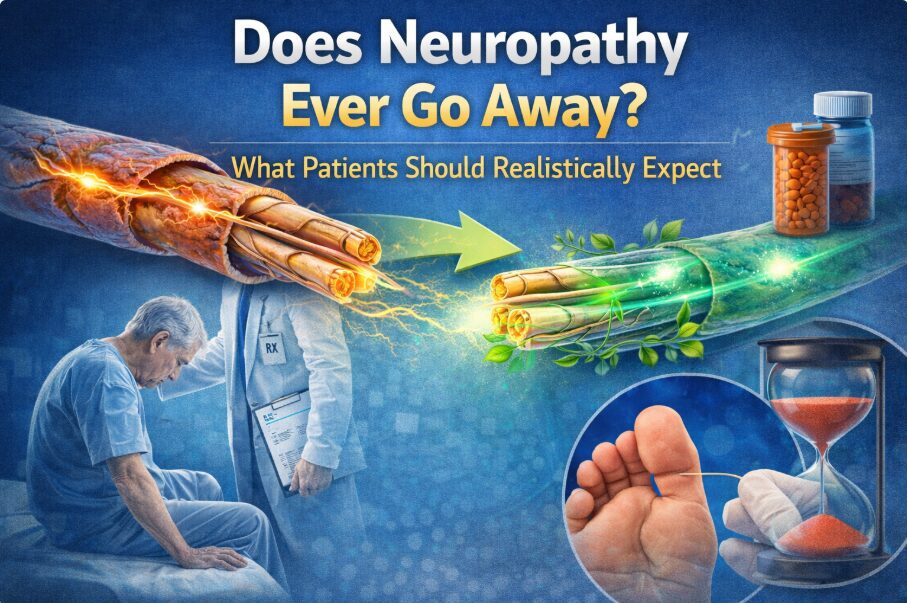

One of the most common questions patients ask is:
“Will this just go away on its own?”
The answer depends on the type and stage of neuropathy.
Some acute neuropathies can resolve.
Most chronic neuropathies do not simply disappear without intervention.
Understanding that distinction is important.
When Neuropathy Can Go Away
Certain types of neuropathy may improve significantly when the underlying cause is addressed early, such as:
- Vitamin deficiency neuropathy
- Medication-induced neuropathy
- Acute inflammatory neuropathy
In these cases, removing the trigger quickly increases the likelihood of recovery.¹
Timing matters.
Chronic Neuropathy Is Different
Most long-standing metabolic neuropathies — including those related to diabetes or vascular stress — do not typically “go away” on their own.
Untreated neuropathy commonly progresses gradually over time.
For more on progression, see: Is Neuropathy a Progressive Disease?
Waiting for spontaneous resolution is rarely effective in chronic cases.
Disappearance vs. Improvement
There is an important difference between:
- Complete disappearance
- Measurable improvement
In over 20 years of focused neuropathy practice, I have not consistently observed chronic neuropathy completely erase itself without structured intervention.
However, measurable improvements in nerve function are often achievable.
For more on reversal potential, see: Can Nerve Damage Be Reversed?
Improvement does not require total disappearance.
It requires altering trajectory.
What Improvement Can Look Like
Patients may experience:
- Increased light-touch detection
- Improved vibration sense
- Reduced burning intensity
- Improved balance stability
- Increased walking endurance
Many patients seeking care are less concerned about pain and more concerned about:
- Instability
- Weakness
- Fear of falling
Pain suppression alone does not restore nerve performance.
Functional improvement requires targeted, stage-specific intervention.
Why Exercise Alone Rarely Makes It “Go Away”
Exercise is essential for strength and balance.
But in chronic neuropathy, I have not consistently observed exercise alone restore measurable sensory nerve function.
Movement supports recovery.
It does not typically regenerate damaged nerve tissue by itself.
For more on exercise, see: Can Exercise Improve Neuropathy?
Does Early Treatment Change the Outcome?
Yes.
Earlier-stage neuropathy tends to respond more predictably than advanced-stage neuropathy.
For staging clarity, see: What Stage of Neuropathy Am I In?
The longer neuropathy progresses untreated, the more structural change may occur.
Earlier intervention often produces more efficient and meaningful gains.
So… Will It Go Away?
In acute cases, possibly.
In chronic cases, not typically without intervention.
But that does not mean nothing can improve.
Peripheral nerves retain capacity for measurable improvement.
The realistic goal is not passive disappearance.
It is structured recovery.
The Most Important Takeaway
Some acute neuropathies can resolve when treated early.
Most chronic neuropathies do not simply go away on their own.
Untreated neuropathy commonly progresses.
However, measurable improvements in nerve function, balance, and stability are achievable with structured care.
Disappearance is not the only measure of success.
Improvement matters.
Timing matters.
Frequently Asked Questions
Can neuropathy disappear completely?
Acute cases may improve significantly. Chronic cases rarely disappear without intervention.
Will neuropathy go away if I control my blood sugar?
Improved metabolic control may slow progression but does not always restore lost nerve function.
Is neuropathy permanent?
Chronic neuropathy often persists, but measurable improvement is achievable.
Can long-standing neuropathy improve?
Yes. Improvement may require structured and consistent intervention.
Next Step
If neuropathy symptoms are affecting sensation, balance, or confidence walking — whether painful or not — structured evaluation can clarify your stage and improvement potential.
To learn more or request a consultation at Realief Neuropathy Centers of Minnesota, call 952-456-6160 or submit a request through our website.
Neuropathy does not typically disappear on its own.
But improvement is possible.
About the Author
Dr. Timothy Kelm is the founder of Realief Neuropathy Centers of Minnesota and has spent over 20 years focused exclusively on the evaluation and treatment of peripheral neuropathy. He has worked with thousands of neuropathy patients and delivered tens of thousands of neuropathy-focused treatments.
He is associated with published clinical research conducted in collaboration with the University of Minnesota and holds a nationally issued patent related to neuropathy treatment methodology. He has delivered public educational presentations and trained physicians nationally on structured neuropathy care.
Over 20 years ago, his interest in neuropathy began after repeatedly seeing patients who were told there were no good options. He believed then — and continues to believe today — that neuropathy should not define your life.