

Many patients worry:
“If neuropathy is progressing… can it reach my heart?”
The short answer is:
Peripheral neuropathy does not damage the heart muscle itself.
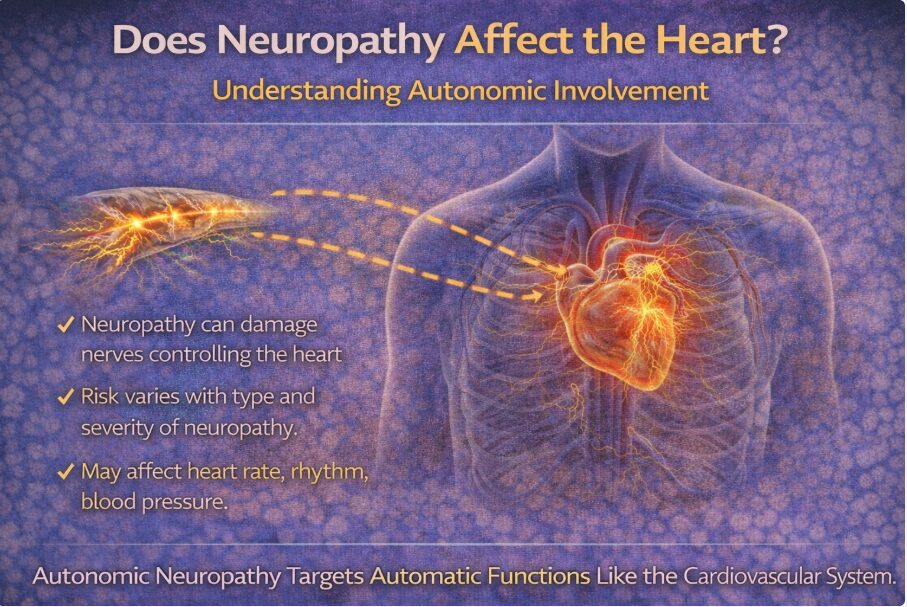
However, certain forms of neuropathy can affect the nerves that regulate heart function.
Understanding that distinction matters.
Peripheral Neuropathy vs. Autonomic Neuropathy
Most peripheral neuropathy affects:
- Sensory nerves
- Balance perception
- Motor coordination
This is the type that causes:
- Numbness
- Tingling
- Burning
- Instability
These symptoms do not directly affect the heart.
However, there is a subtype called autonomic neuropathy.
Autonomic nerves regulate:
- Heart rate
- Blood pressure
- Digestion
- Temperature control
When autonomic nerves are affected, regulation can change — even though the heart muscle itself remains structurally normal.
What Cardiac Autonomic Neuropathy Looks Like
In more advanced systemic disease — particularly long-standing diabetes — autonomic involvement may lead to:
- Resting heart rate changes
- Reduced heart rate variability
- Lightheadedness when standing
- Blood pressure instability
This is not common in early-stage neuropathy.
It typically occurs in cases of long-standing, poorly controlled systemic disease.
For more on progression patterns, see:
How Fast Does Neuropathy Progress?
Does It Increase Risk of Heart Disease?
Neuropathy itself does not cause coronary artery disease.
However, both neuropathy and heart disease may share common risk factors, such as:
- Diabetes
- Metabolic syndrome
- Vascular disease
- Chronic inflammation
When neuropathy is present, it may reflect underlying systemic stress.
It is a marker — not a direct cause — of heart disease.
Is It Dangerous?
Severe autonomic neuropathy can increase certain risks, including:
- Blood pressure drops
- Dizziness
- Increased fall risk
For safety thresholds, see:
When Is Neuropathy Dangerous?
However, neuropathy rarely causes fatal cardiac events directly.
For mortality concerns, see:
Can Neuropathy Cause Death?
The greater concern in most cases is reduced stability and quality of life — not cardiac failure.
Does Neuropathy Spread Into the Heart?
No.
Peripheral neuropathy does not spread into heart muscle tissue.
For brain-related concerns, see:
Does Neuropathy Spread to the Brain?
Autonomic nerve involvement affects regulation — not structural invasion.
This distinction reduces unnecessary fear.
Can Autonomic Symptoms Improve?
Peripheral nerves — including autonomic fibers — retain some capacity for functional improvement.
In clinical practice, measurable improvements in nerve function may include:
- Improved sensory detection
- Improved balance
- Reduced burning
- Increased endurance
Autonomic regulation improvement depends heavily on:
- Metabolic control
- Vascular health
- Timing of intervention
Earlier structured care tends to produce more predictable gains.
Untreated neuropathy commonly progresses.
But progression is not destiny.
The Most Important Takeaway
Peripheral neuropathy does not directly damage the heart.
In advanced cases, autonomic nerves that regulate heart rate and blood pressure may be affected — particularly in long-standing systemic disease.
Neuropathy itself is rarely fatal.
Its primary impact is on sensation, balance, and independence.
Untreated neuropathy commonly progresses.
However, measurable improvements in nerve function and stability are achievable — especially when addressed earlier rather than later.
Fear of heart involvement is understandable.
Catastrophic spread into the heart is not how neuropathy works.
Frequently Asked Questions
Q: Can neuropathy cause heart failure?
A: No. Peripheral neuropathy does not damage the heart muscle.
Q: What is cardiac autonomic neuropathy?
A: It is involvement of autonomic nerves that regulate heart rate and blood pressure.
Q: Is autonomic neuropathy common?
A: It is most often seen in advanced, long-standing systemic disease.
Q: Should I worry about my heart if I have neuropathy?
A: Most cases affect sensation and balance, not cardiac function.
Next Step
If you are experiencing lightheadedness, blood pressure instability, or changes in heart rhythm, evaluation by your primary care provider or cardiologist is appropriate.
If neuropathy symptoms are gradually progressing in sensation or balance, earlier structured evaluation often allows for more efficient intervention before functional decline advances.
To learn more or request a consultation at Realief Neuropathy Centers of Minnesota, call 952-456-6160 or submit a request through our website.
Neuropathy affects regulation — not heart muscle.
Timing protects function.
About the Author
Dr. Timothy Kelm is the founder of Realief Neuropathy Centers of Minnesota and has spent over 20 years focused exclusively on the evaluation and treatment of peripheral neuropathy. He has worked with thousands of neuropathy patients and delivered tens of thousands of neuropathy-focused treatments.
He is associated with published clinical research conducted in collaboration with the University of Minnesota and holds a nationally issued patent related to neuropathy treatment methodology. He has delivered public educational presentations and trained physicians nationally on structured neuropathy care.
Over 20 years ago, his interest in neuropathy began after repeatedly seeing patients who were told there were no good options. He believed then — and continues to believe today — that neuropathy should not define your life.