
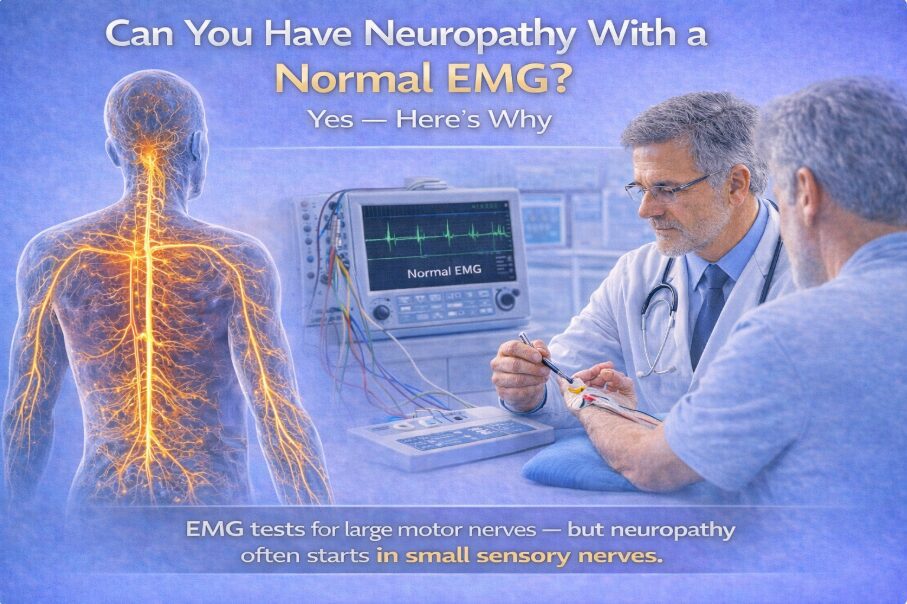

One of the most frustrating things patients hear is this:
“Your EMG is normal.”
Yet the burning, tingling, numbness, tightness, or temperature sensitivity continues.
This creates confusion.
If the test is normal, how can symptoms still be present?
The answer lies in understanding what an EMG measures — and what it does not.
What an EMG Actually Tests
An EMG (electromyography) and nerve conduction study evaluates electrical activity in nerves and muscles.
It primarily measures:
- Large myelinated nerve fibers
- Conduction velocity
- Motor unit response
These large fibers are responsible for:
- Vibration sensation
- Muscle activation
- Reflexes
EMG is excellent at detecting large fiber neuropathy, radiculopathy, and motor involvement.¹
But not all neuropathy affects large fibers first.
What EMG Does Not Measure
Small fiber nerves are thin, lightly myelinated or unmyelinated fibers responsible for:
- Pain sensation
- Temperature detection
- Autonomic regulation
Small fiber neuropathy can cause:
- Burning
- Tingling
- Electric-like sensations
- Tightness
- Heat intolerance
Because these fibers are too small to be measured by standard nerve conduction studies, EMG may appear normal.²
This is one of the most common reasons patients are told “everything looks fine” despite persistent symptoms.
Small Fiber Neuropathy Is Real
Small fiber neuropathy is well-documented in medical literature.³
It may be associated with:
- Diabetes
- Pre-diabetes
- Autoimmune conditions
- Chronic kidney disease
- Metabolic dysfunction
- Idiopathic causes
Symptoms often begin in the toes and progress upward in a length-dependent pattern.
But diagnostic testing may lag behind symptom onset.
Why This Creates Frustration
When patients are told their EMG is normal, several things may happen:
- Symptoms are minimized
- Anxiety increases
- Care stalls
- The search for answers becomes fragmented
A normal EMG does not rule out neuropathy.
It simply rules out certain types of neuropathy.
That distinction matters.
Other Ways Small Fiber Neuropathy Is Evaluated
While EMG evaluates large fibers, small fiber neuropathy may be assessed through:
- Clinical pattern recognition
- Sensory mapping
- Skin biopsy for nerve fiber density
- Quantitative sensory testing
Skin biopsy has been used in research and specialty settings to measure intraepidermal nerve fiber density.⁴
However, clinical pattern recognition remains central.
The Role of Autonomic Symptoms
Small fibers also influence autonomic function.
This means patients with normal EMG results may also report:
- Lightheadedness when standing
- Digestive slowing
- Heat intolerance
- Tightness in the lower legs
These patterns reinforce that neuropathy can exist beyond large fiber testing.
Why Pattern Recognition Matters
Over more than 20 years focused exclusively on neuropathy care, one consistent observation stands out:
Symptoms often precede objective large fiber abnormalities.
Waiting for EMG changes may delay recognition of small fiber involvement.
Clarity requires understanding the limits of testing.
The Most Important Takeaway
Yes — you can have neuropathy with a normal EMG.
EMG is an important tool.
It is not a complete tool.
When symptoms follow a neuropathic pattern, further evaluation may be appropriate even if standard testing is normal.
Clarity prevents dismissal.
Frequently Asked Questions
Q: Can neuropathy exist with a normal EMG?
A: Yes. Small fiber neuropathy may not be detected on routine EMG testing.
Q: What does an EMG actually test?
A: EMG primarily evaluates large myelinated nerve fibers and motor function.
Q: How is small fiber neuropathy diagnosed?
A: Diagnosis may involve clinical pattern recognition, sensory testing, or specialized skin biopsy.
Q: If my EMG is normal, should I stop looking for answers?
A: Not necessarily. Persistent symptoms deserve thoughtful evaluation.
Next Step
If you have persistent burning, tingling, tightness, temperature sensitivity, or autonomic symptoms despite a normal EMG, a structured neuropathy evaluation can help clarify whether small fiber involvement may be present.
To learn more or request a consultation at Realief Neuropathy Centers of Minnesota, call 952-456-6160 or submit a request through our website.
Early clarity can influence long-term trajectory.
About the Author
Dr. Timothy Kelm is the founder of Realief Neuropathy Centers of Minnesota and has spent over 20 years focused exclusively on the evaluation and treatment of peripheral neuropathy. He has worked with thousands of neuropathy patients and delivered tens of thousands of neuropathy-focused treatments.
He is associated with published clinical research conducted in collaboration with the University of Minnesota and holds a nationally issued patent related to neuropathy treatment methodology. He has delivered public educational presentations and trained physicians nationally on structured neuropathy care.
Over 20 years ago, his interest in neuropathy began after repeatedly seeing patients who were told there were no good options. He believed then — and continues to believe today — that neuropathy should not define your life.
References
- American Association of Neuromuscular & Electrodiagnostic Medicine. Electrodiagnostic testing overview.
- Oaklander AL. Small-fiber neuropathy. Neurol Clin.
- Devigili G et al. The diagnostic criteria for small fiber neuropathy. Brain.
- Lauria G et al. Intraepidermal nerve fiber density in small fiber neuropathy. Neurology.